Research Note: Wicked 'Zero-Sum' Game(s)
In my work, I often emphasize the need for values-based coordination and decision-making as a foundation for making the music industry better. While I believe deeply in this approach, it’s also true that capitalism’s institutional incentive structures rarely make it easy to act on shared values. Music is a minefield of competing incentives across stakeholders. I often remind people, for e.g., that even “artist” is a multi-layered category, and that incentives can diverge significantly within it depending on whether someone is a recording artist, songwriter, featured performer, or some combination of those roles.1
I was thinking about the individual binds and incentives placed on artists because of a tweet and related article that has been making the rounds:
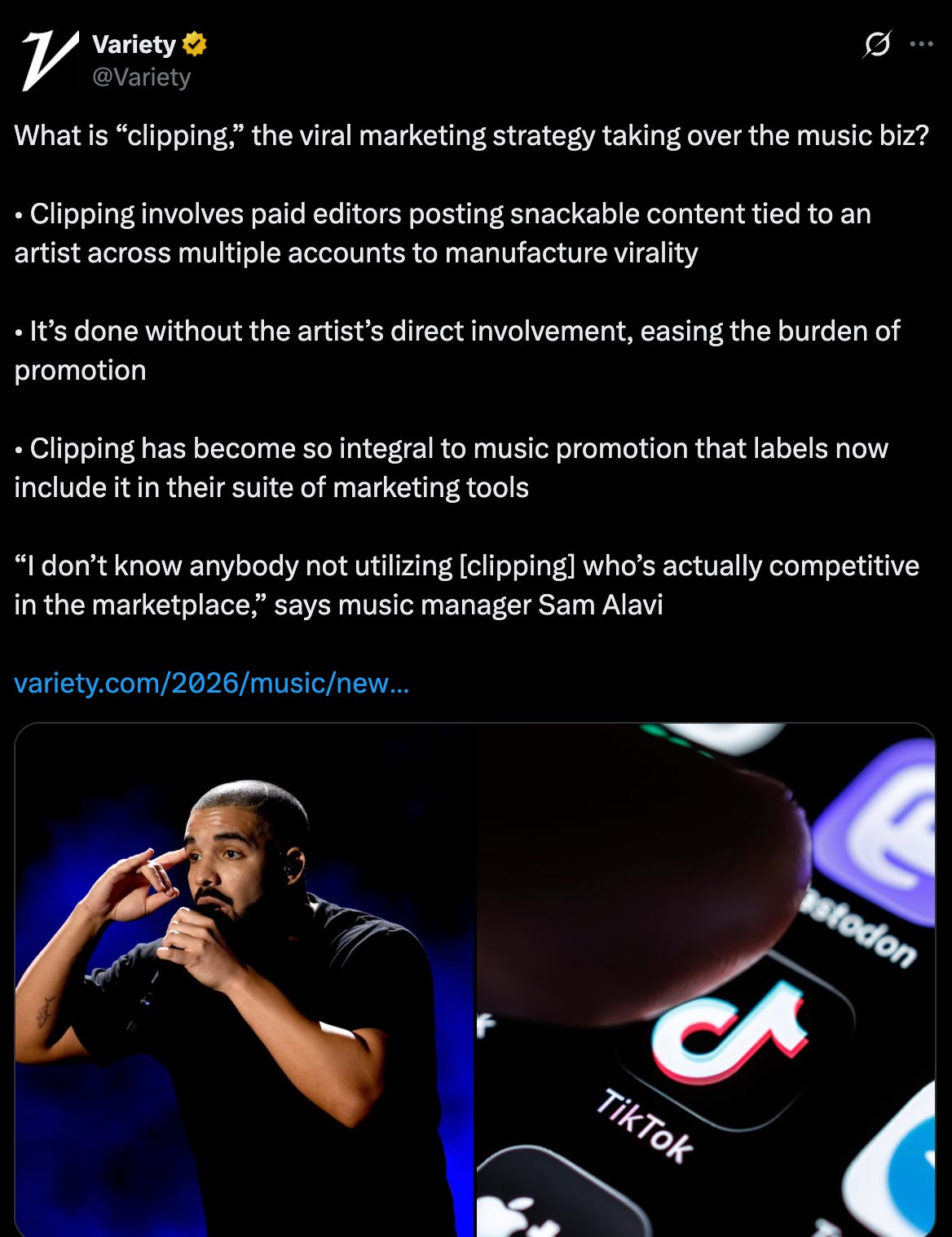
The article describes the practice of clipping in music marketing, where songs are inserted into short-form videos posted by paid networks of meme, fan, or influencer-style accounts, to simulate organic buzz and drive attention to an artist on social platforms like TikTok.
The first thing that struck me about clipping is that it is, on its face, deceptive. At best, it’s grey-hat marketing, and pretty clearly a shifty way to game the system, and consequently, to undermine trust between artists and fans. To me, this is part of a broader enshittification of the artist-fan relationship, by taking what ought to be an affective connection grounded in art, culture, and shared meaning, and collapsing it into a fully commodified transaction aimed at maximizing financial gain.
Still, whatever one thinks of the ethics, clipping appears to be widely used. The replies to the tweet make that clear:
“Clipping is so big in streaming and hip-hop. Shocked every industry isn’t leaning in more”
“Clipping isn’t new but its adoption in music marketing is worth paying attention to. For artists, the upside is real. Many dislike making content, and clipping reduces that burden. And compared to traditional marketing spend, the costs are lower, which means faster recoupment.”
“Is there a way to do this for writing?”
So, why do artists and music companies use it despite pretty obvious ethical defects? Is this an individual lapse in morality? Or the result of structural forces? Hint: It is almost always the latter w/ capitalism!
Platforms and organizations exploit the structural logic of the attention economy. Because attention operates as a zero-sum field, in order to gain a foothold, one naturally has to leap over others. With this structural incentive built in, it’s a simple hop skip and jump to building systems designed to exploit it for profit.
A key problem is that these zero-sum incentives are fundamentally short-term in orientation. They’re geared toward maximizing immediate individual advantage and capturing ever more attention-market share which, in practice, usually also means greater economic market share. Music manager Sam Alavi captures the bind that artists face well: “I don’t know anybody not utilizing [clipping] who’s actually competitive in the marketplace.”
As I’ve written before with respect to catalog acquisitions, a fixation on short-term financial incentives can produce an ouroboros effect, where we consume our own tail, undermining the long-term sustainability of music in exchange for immediate payouts. The same logic applies to clipping.
At the institutional level of major labels and private equity, that logic is structurally embedded and often knowingly pursued by the people in charge. But with practices like clipping, which operate at the level of individual artists and their teams, the tradeoff is more obscured. In that sense, artists may be unwittingly participating in the deterioration of the very ecosystem they depend on.
With a bit of analysis, we can see how the internal logic of clipping undermines the future sustainability of music. The attention economy encompasses the full universe of things people might do with their time, whether watching sports, endlessly scrolling social feeds, gaming, or listening to music. Music is already structurally squeezed within that economy, and is often reduced to an underpaid supplement that helps keep attention locked onto other mediums, especially short-form video.
Clipping deepens that problem. By paying fake influencers to saturate social feeds with inauthentic content, artists aren’t just chasing attention away from one another; they’re also cutting into the limited time and cognitive space audiences could be using to engage with music more directly. In doing so, they help intensify the kind of low-trust environment often described by ‘dead internet theory’, where feeds are dominated less by genuine cultural exchange than by manufactured signals, fake participation, and algorithmically optimized slop.2
This also creates a classic collective action problem that manifests as a race to the bottom. As more artists adopt clipping to remain competitive, the wider attention environment becomes more degraded, while any advantage gained from the tactic is also diminished by its general uptake. The result is a self-reinforcing loop in which artists compete for advantage on terms that, collectively, erode the foundation that makes meaningful musical engagement possible.
Clipping is just one of many examples of how race-to-the-bottom dynamics are weaponized within the systems artists are forced to navigate, and by the organizations powerful enough to shape those systems.
Once we know what to look for, we can see the same logic at work across the music ecosystem. Spotify’s Discovery Mode is another example. The program allows artists and rights holders to trade reduced streaming royalty rates for beneficial placement within Spotify’s personal playlist algorithms. It’s a way for artists to buy their way to the front of the attention-line. The structural gains and profits from that tradeoff, however, flow primarily to Spotify and its shareholders. For artists, the deal is much less compelling. If enough artists opt in, the relative advantage of preferential placement is effectively neutralized, since everyone is once again competing on the same terms. When everyone’s super, no one will be. Except now Spotify has succeeded in lowering its overall payment obligations to artists at scale. As with clipping, the apparent short-term individual incentive obscures a deeper long-term tradeoff where participation may offer marginal career gains in the present, while helping normalize a system that erodes music’s long-term sustainability.
With race-to-the-bottom logics seemingly everywhere, the problem is that coordination against them is difficult to organize. The only way out is collective action, but the challenge of coordinating to build the shared values, trust, and long-term strategic horizons necessary for that action is hard. Artists are atomized within their own careers, and pushed to survive as individual competitors inside systems they don’t control. At the same time, austerity and broader economic trends continue to hollow out the infrastructure that makes collective constellations possible. Grassroots venues remain precarious, community institutions are under strain, and arts funding is often among the first things to be cut. The result is a music ecosystem in which the need for coordination is obvious, but the conditions for achieving it are structurally undermined.
Nonetheless, we persist! There are efforts to build this kind of coordination among artists. UMAW, for example, is explicitly organized around a values-based vision of a more just music industry, and has mobilized artists and music workers together around issues including streaming pay, merch cuts, education, and international solidarity.3 The Reset Network is doing similar, values-oriented work in Europe. In policy, the Protect Working Musicians Act in the US points in a related direction. It is an attempt to give independent music creators greater ability to negotiate collectively with dominant streaming platforms and AI companies, rather than leaving them isolated in one-on-one encounters with concentrated corporate power.
Ultimately, coordination and collective action are hard, especially at scale. Organizing is slow, demanding work. But if our analysis of these structural tendencies is correct ( and I believe it is), then there is no real alternative to it. If these dynamics systematically push music toward race-to-the-bottom outcomes, then individual moral choices or isolated acts of resistance will never be enough. The only adequate response is to build the forms of solidarity, organization, and collective power capable of contesting them. At the risk of sounding like a broken record, if we care about the future of music, we have to organize!
Some Music!
I was excited to see that Cole Pulice is coming through Ottawa in May and performing at Fono, a very cool new small venue, community space, and hi-fi listening room opening literally 40 feet from my apartment. My friend and ambient wizard Nick Schofield is opening. I am a lucky guy!
I’ve been obsessed with Pulice’s latest album ‘Land’s End Eternal’ since it came out last year. I love its sense of space, and the textures, and, sacrilege though it may be to tube amp purists, I absolutely adore the digital-artifact sounding direct-in guitar tone that anchors the album.
These diverging incentives are, of course, rooted in the institutional logic of capitalism and in the way intellectual property systems are structured. I think we could do much better on that front, but, alas, today is not the day I make the case for overturning the entire global copyright regime, tempting though it is.
🙏 A tip o’ the hat to lofi climate who brought the connection to Dead Internet Theory to my attention.
Disclosure: I am a proud, dues-paying UMAW member ✊.